
Business security is no longer limited to a siren, a keypad, and a lock on the front door. For many commercial sites, the more effective approach is to connect multiple layers of protection so that entry permissions, alarm responses, and restricted areas work together. That is why many organisations now treat Burglar Alarm Perth solutions as part of a wider site security framework rather than as a standalone installation.
In practical terms, access control and alarm integration allow a business to decide who can enter, where they can go, when they can enter, and what happens if that movement falls outside approved rules. For offices, warehouses, medical rooms, retail stores, workshops, and multi-tenant premises, this joined-up model gives clearer oversight and stronger control.
What access control and alarm integration means
Access control manages entry to a site or to selected parts of a building. This may include door keypads, card readers, swipe access, fobs, PIN entry, mobile credentials, or biometric readers. A burglar alarm system detects unauthorised entry, forced access, movement after hours, or activity in protected zones.
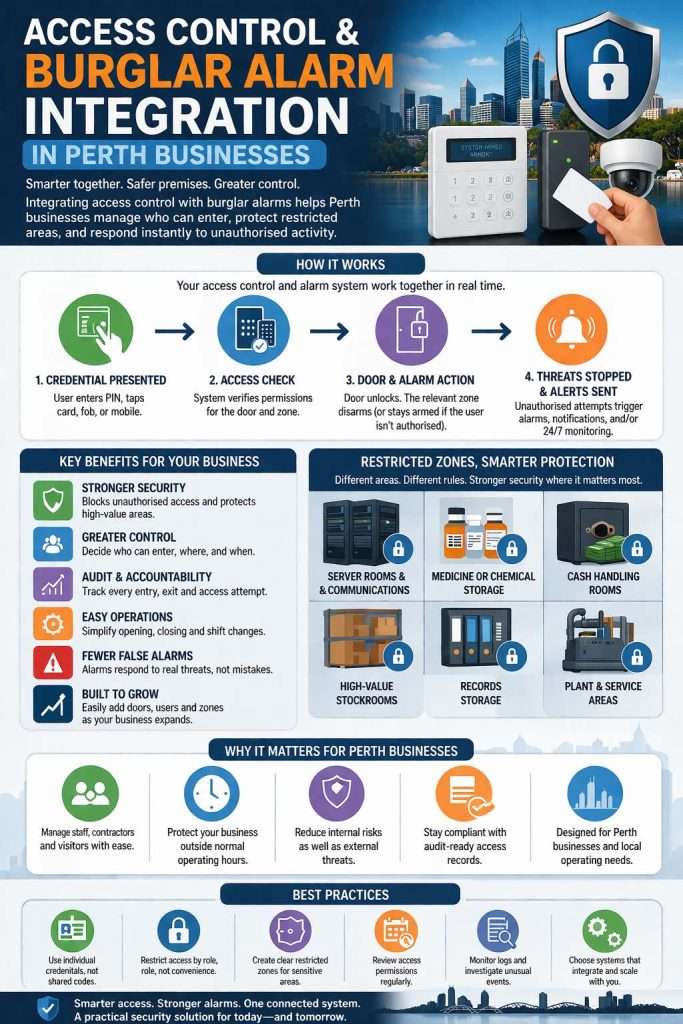
When these systems are integrated, they do not operate separately. Instead, they exchange information. A valid credential can disarm a selected area. An invalid access attempt can trigger an alert. A door forced open without authorisation can activate the alarm logic for that zone. A staff member may be allowed into one part of the building but not into a server room, stock cage, records room, or management office.
This arrangement improves control because the system responds to actual site permissions rather than relying only on a manual arm and disarm routine.
Why integration matters for Perth businesses
Many Perth businesses operate from premises with multiple access points, varied staffing hours, and different levels of authorised access. A simple alarm system may protect the building perimeter, but it does not always manage internal movement in a precise way. Integration solves that gap.
A connected setup can help businesses:
- control staff, contractor, and visitor entry
- restrict access to sensitive rooms or high-value stock areas
- reduce the risk of internal security breaches
- create a clearer audit trail of who entered specific zones
- simplify opening and closing procedures
- reduce false alarms caused by incorrect disarming
- improve after-hours protection across different parts of the premises
This is one reason many operators reviewing Security Systems Perth options look beyond standalone devices and instead assess how each component works within a complete commercial security environment.
The role of keypads in integrated systems
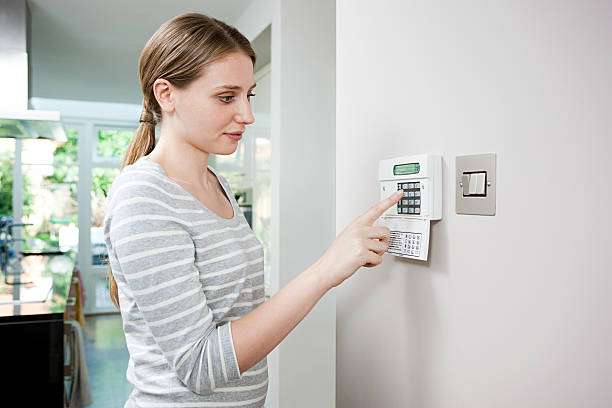
Keypads remain a common part of commercial security, especially where businesses need a practical and familiar method for arming and disarming. In an integrated environment, the keypad does more than switch the alarm on or off.
It can be programmed to manage specific partitions or areas within a building. For example, a warehouse office may be disarmed at 6:30 am by an authorised supervisor while the rear storage area remains armed until approved warehouse staff arrive. In a multi-use building, one business tenancy can disarm its own section without affecting others.
Keypads can also support duress codes, time-based permissions, and event logging. That means management can review when a code was used, which area changed status, and whether the action matched expected operating hours.
How swipe systems improve controlled entry
Swipe cards, prox cards, fobs, and credential-based readers are often used where businesses need fast, repeatable access for multiple staff members. Unlike a shared PIN, an individual credential can be linked to a specific person, which improves accountability.
When linked with the alarm platform, swipe access can perform several functions at once. A valid card can unlock a door, record the entry, and disarm an approved section. If a card is used at the wrong time or on the wrong door, the system can deny access and log the event for review.
This matters in premises where there are changing shifts, casual staff, contractors, or cleaning teams. It allows the business to grant only the level of access required, for only the required period. If a card is lost or a staff member leaves the business, permissions can be removed without the need to rekey locks across the site.
Restricted zones and why they matter
Not every part of a building should be equally accessible. In many Perth businesses, certain areas carry a higher operational, financial, or compliance risk than others. Examples include:
- server and communications rooms
- medicine or chemical storage
- cash handling rooms
- stockrooms with high-value inventory
- records storage
- management offices
- plant rooms and service areas
Restricted zones allow a business to separate those areas from general circulation spaces. Integration with alarms adds another control layer. If a restricted zone is accessed without authorisation, or if motion is detected after the approved access window, the system can escalate the response.
This can include a local alarm, a signal to monitoring, a notification to management, or a requirement for manual verification. For higher-risk environments, restricted zone programming is often one of the most useful features in a properly designed Burglar Alarm Perth setup.
Operational benefits beyond intrusion detection
Integrated security is not only about stopping break-ins. It also supports day-to-day site management. For many businesses, the operational value is just as important as the protective value.
An integrated system can support:
Cleaner opening and closing procedures
The first authorised staff member can unlock and disarm only the areas they need. The last person leaving can re-arm designated zones without manual workarounds or site-wide guesswork.
Better user accountability
Each credential, code, or entry event can be tied to a specific user. This creates a more reliable event history than shared keys or generic alarm codes.
Reduced administration
User permissions can be edited centrally. Businesses can add, change, or remove access rights without replacing physical locks throughout the premises.
Improved incident review
If there is an alarm, management can compare alarm activity against door events, access attempts, and timing records to understand what happened.
Stronger support for growing sites
As a business expands, additional doors, zones, and user groups can often be incorporated into the same security framework rather than installed as isolated systems.
Design considerations for commercial integration
Good integration depends on planning, not just hardware selection. The layout of the premises, staffing structure, business hours, risk profile, and future growth plans all affect the design.
Key questions include:
- Which doors require controlled access?
- Which areas need separate alarm partitions?
- Are there staff with different permission levels?
- Are there contractors or after-hours cleaners?
- Which rooms require higher protection or restricted entry?
- Does the site need audit reporting?
- Should alarms trigger monitoring, internal notifications, or both?
A retail store, for example, may prioritise stockrooms, rear entries, and delivery access. A medical practice may focus more on records areas, drug storage, and staff-only spaces. A warehouse may require separate controls for office, loading, and storage sections. This is why Security Systems Perth planning should always reflect the operating reality of the site rather than follow a generic template.
Common mistakes businesses should avoid
Some of the most common issues in commercial security come from poor integration decisions rather than equipment failure.
These include:
- using shared credentials instead of individual user access
- failing to separate high-risk rooms into distinct restricted zones
- giving broad access rights to staff who only need limited entry
- relying on manual disarming routines across large premises
- not reviewing access logs or alarm events regularly
- installing systems that cannot scale with site growth
- treating access control and alarms as separate projects
A business may invest in strong devices but still end up with weak control if permissions, zoning, and event logic are not planned properly.
A more practical security model for Perth businesses
Commercial sites need more than basic entry control and more than a siren triggered after unauthorised access. They need a system that manages real people, real movement, and real risk across the premises. Integrating alarms with keypads, swipe systems, and restricted zones gives businesses a more structured way to protect staff, assets, records, and operational areas.
For Perth businesses reviewing site protection, the strongest result usually comes from connecting access permissions with alarm responses so that every authorised entry, denied attempt, and protected zone works within one controlled framework. That approach gives a clearer security picture, reduces avoidable gaps, and makes commercial protection more practical over time.